
ANCIENT EGYPTIAN BURIAL CHAMBER SCENOGRAPHY
For the Ancient Egyptian artefact display at the Museum of the Ancient Orient in Istanbul, we designed and produced an original scenographic setting that evokes the atmosphere of an ancient burial chamber. Every stage—including research, digital design, three-dimensional modelling, 3D printing, surface finishing, artistic painting and on-site installation—was developed as part of an integrated production process.
HISTORICAL RESEARH & SCENOGRAPHIC INTERPRETATION
The scenographic composition was inspired by the Judgement Scene from the Papyrus of Ani, held in the British Museum collection. This scene from the Book of the Dead of Ani depicts the weighing of the heart, Anubis overseeing the scales, Thoth recording the result and the assembled deities witnessing the judgement.
The project was not conceived as a direct reproduction of this scene. Alongside the Papyrus of Ani, a broad range of Ancient Egyptian tomb paintings, papyri, stone reliefs, figures and hieroglyphic compositions were studied. These visual references were reinterpreted according to the dimensions of the display case, the positions of the artefacts and the overall burial chamber concept.
The scale, movement and relationships of the figures, as well as their hierarchy within the composition, were defined through an extensive research and analysis process.The result was a new and cohesive relief composition, informed by historical sources yet designed specifically for its architectural and museological setting.

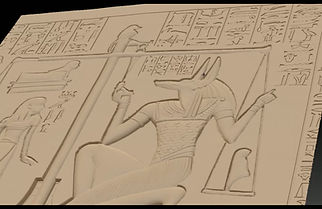
DIGITAL SCULPTING & DATA DESIGN
The composition was translated into three dimensions using digital sculpting and CAD-based modelling techniques.Figures, hieroglyphs, frames and background textures were developed as separate layers. The height and depth of each relief element were carefully adjusted according to the shadows and visual effects they would create under the display lighting.
During the transformation of two-dimensional references into three-dimensional reliefs, particular attention was given to preserving the characteristic proportions and combined frontal–profile visual language of Ancient Egyptian art.
Subtle irregularities, traces of wear and controlled variations in texture were incorporated into the digital model to evoke the character of hand-carved stone and avoid an overly mechanical appearance.Once modelling was complete, all geometry underwent a detailed technical review. Open surfaces were repaired, mesh density was optimised, surface defects were corrected and the models were converted into watertight geometries suitable for 3D printing.
The large-scale relief was then divided into manufacturable sections according to printer build volumes, transportation requirements and the installation method, while ensuring that the joints could be concealed within the composition.
SLICING & 3D PRINTING PARAMETERS
The production-ready models were transferred to professional slicing software. The geometry of each component was evaluated individually to determine the most appropriate printing orientation, build-plate position, support requirements and production time.
Suitable layer heights were selected according to the level of detail and surface characteristics of the reliefs. Finer layer settings were used for delicate hieroglyphs, figure details and subtle surface transitions, while broader and flatter areas were optimised to achieve an effective balance between production time and surface quality.
Wall thicknesses, infill ratios and shell counts were defined according to the dimensions and intended position of each component. The primary objectives were to minimise long-term deformation across large surfaces, ensure that the components could safely support their own weight and provide sufficient mechanical strength during assembly. Joints were reinforced where necessary, while reference surfaces and connection details were incorporated to ensure accurate alignment during transportation and installation.
Printing orientation was also determined by considering the visibility of layer lines, possible marks from support structures and the mechanical behaviour of each component during production. This approach helped minimise detail loss and enabled the subsequent surface-finishing stages to be carried out in a controlled manner.


3D PRINTING &
QUALITY CONTROL
Following slicing, the components were manufactured using our professional 3D printers.
Throughout the extended printing cycles, layer formation, build-plate adhesion, dimensional accuracy and production continuity were regularly monitored. Each completed component was compared with the digital model and its adjoining parts to verify dimensional compatibility.
Support structures were carefully removed, joint surfaces were cleaned and trial assemblies were completed before final installation. Figures, hieroglyphs and relief depths were inspected, with local corrections applied wherever necessary.
ASSEMBLY & SURFACE FINISHING
The completed components were assembled according to the predetermined installation sequence. Alignment, level and continuity of the relief were carefully checked at every joint. Seams were then concealed through filling and surface-finishing applications without compromising the visual integrity of the composition.
Layer lines and assembly joints resulting from the segmented production method were eliminated through controlled sanding, filling, priming and local surface correction. Rather than applying heavy coatings in a single stage, these treatments were repeated in thin layers to preserve the fine surface details. This allowed the figures, hieroglyphs and textures to remain clearly legible while creating the appearance of a single, continuous stone relief.
Suitable preparation and protective layers were applied to improve surface durability and provide a stable base for the painting process. Artefact safety was prioritised when selecting all materials intended for use inside the display case; VOC-free products suitable for enclosed museum environments were chosen.


RECREATING ANCIENT EGYPTIAN COLOURS
Before the scenographic surfaces were painted, the pigments, colour distribution and tonal relationships found in Ancient Egyptian art were studied.
A custom colour palette was developed with particular reference to characteristic historical colours, especially yellow ochre and Egyptian blue.
Colour was treated not merely as a decorative element, but as an essential design component that distinguishes the figures, improves the legibility of the narrative and gives the scene its historical character.
Painted samples were evaluated under different lighting conditions, with particular attention to their appearance under the final display illumination.
ARTISTIC PAINTING & PATINATION
The painting process was carried out entirely by hand by our artists using a multilayered approach. The principal colour fields were applied first, followed by tonal transitions, shading, surface highlights and detailed painting.
Darker tones were used within recessed areas to emphasise the depth of the relief, while controlled highlights were applied to projecting figures and hieroglyphs. Layered colouring, dry brushing, washes, ageing, patination and local highlighting techniques were combined to reduce the appearance of a newly manufactured surface.
Natural variations in colour, wear and shadow associated with aged stone were artistically reinterpreted. This process gave the digitally modelled and 3D-printed surfaces the organic character and individuality of hand craftsmanship.


MUSEUM INSTALLATION & FINAL INSPECTION
Once the workshop production was complete, the scenographic components were transported to the museum and installed inside the display case according to the predetermined assembly plan.
Joints, panel continuity and the relationship between the relief and its surrounding surfaces were checked again. Local retouching and final surface adjustments were then completed, transforming the separate panels into a cohesive burial chamber wall.
Final inspections were carried out under the display lighting to ensure that the figures, hieroglyphs, colour transitions and relief depths could be clearly perceived by visitors. The scenography was designed not to compete with the Ancient Egyptian artefacts on display, but to reinforce their historical context and narrative significance.
Bringing together research, digital sculpting, engineering, 3D printing, craftsmanship and artistic surface finishing, the project created an original museum experience that introduces visitors to Ancient Egyptian beliefs surrounding death, the afterlife and burial culture.